Neurodivergence: The plot twist that rewrote my life story
“I am shaped by this, and because of this I exist as I am.”
As I was transitioning from New York to Sydney, I found out I most likely have a neurodivergent mind: Attention-Deficit / Hyperactivity-Disorder (ADHD), synesthesia and a highly sensitive nervous system (SPS).
This blog is not like my other blog posts, this is a compilation of thoughts and realisations that have been coming to my mind—call it streams of consciousness, downloads or mere aha moments while I’ve been integrating this newfound knowledge and my cognitive style.
★ This is not a linear story, it’s an unfolding. Read it all or jump to what calls you.
The plot twist, someone just changed the script
There was no script for this. Everything points to me having a neurodivergent mind… I like to believe from a spiritual lens that I was at some point in my soul evolution ready to receive this news, and it was going to rewrite my whole life story.
I had a hypnosis session with my dear energy facilitator and soul sister Karla in NYC. She did a prenatal hypnosis session.
How I got into this experience I like to believe it was divine intervention.
I think it was something my mum told me, or maybe it was my intuition, I don’t clearly know. The thing is that I had the session booked right before I left New York and my intention was “to know the root, I wanted to understand, so I can serve others better”. The next day we flew to Sydney.
As the universe has this amazing way of creating perfect scenarios, during that relocation time I was working with design client, she supports kids with challenges in writing and reading. As I was helping her with her website, I read her resources section and that made me click on a book that sounded interesting, which then led me to click somewhere else, and before I knew it I was deep into research mode—remembering my childhood, doing tests, asking my parents questions about my early childhood.
Finally I input all the information into ChatGPT and in seconds it summarised what I was already suspecting.
I actually felt like I was in a plot twist scene and everything was about to change. ADHD, SPS, me?…no way!
What does this mean? As I was diving deeper and deeper into the research, a few books and countless online tests, the truth was sinking deeper and deeper—and the deep realisation that this is huge news! an out-of-this-world mind-blowing and amazing revelation!
I don’t have a formal diagnosis and at this point in time I don’t know if I will seek one. And what is a formal diagnosis anyway? Basically a list of symptoms that someone assesses and you meet those symptoms for a certain duration of time, then you qualify for a formal diagnosis. (This is not to discourage you if you wish to seek one, please go ahead).
Do I need that? Right now, I’m not sure. Time will tell.
I’m self-identified. I have my childhood memories and personal experiences that guided me, and I’m realising I’m ticking all the boxes in the tests—more specifically Vanessita (my little child self) is and I can feel she is jumping and dancing and celebrating right now.
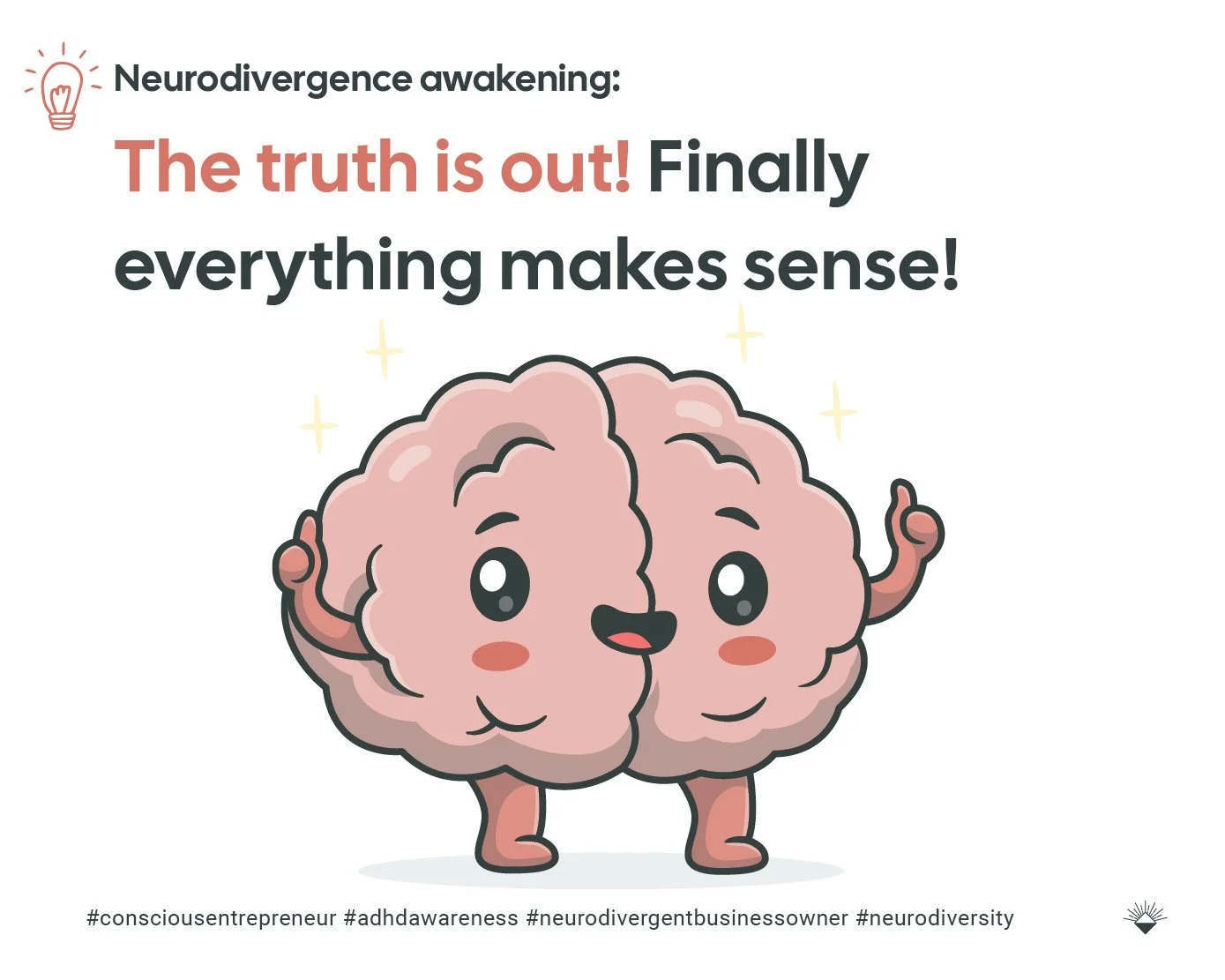
Because above all, I felt deep relief and validation… I felt deep love and compassion for my younger self, and it is definitely rewiring my whole brain. Because remember that our brains are plastic and they can transform.
If you don’t know about neuroplasticity you need to read this book.

Because the more tests I do, the more validation she feels, and the more my brain rewires the old story “there was nothing wrong with me”… the old childhood story of “why am I like this? why can’t I just be like other kids? Why am I always in fairyland”
“It felt like I had just met the real me… and fully accepted her 💗”
What is a neurodivergent mind?
→ di.ver.gent
/daɪˈvəːdʒ(ə)nt/
adjective
Tending to be different or develop in different directions.
→ neu.ro.di.ver.gent
/ˌnjʊərə(ʊ)dʌɪˈvəːdʒ(ə)nt,ˌnjʊərə(ʊ)dɪˈvəːdʒ(ə)nt/
adjective
Differing in mental or neurological function from what is considered typical or normal.
✷✯❊✤✧❋✼❉
In simple terms, it is basically a different cognitive style than the majority—what science calls neurotypical. I personally don’t like labels or pathologising ways of being however, I do appreciate the clarity that this whole experience is bringing me.
It simply explains so much of my life—challenges, reactions, emotions, situations… everything. Even the dynamic with my husband.
After the news, one of the first things I thought was my indigenous teachers… what would they say?
I can almost see their faces if I brought this to them. They would do what they always do when they know I already have the answer within me—look at me with a strange expression, say nothing, and quietly chuckle.
Over time, I’ve learned that this is their way of saying:
“I have no idea what you are talking about… and ultimately, you already know.”
For them, all these labels including anxiety, stress, trauma, are modern attempts of the human mind to categorise, pathologise and box everything… including our own existence and human experience, as if we are little machines.
My maestro (teacher), taught us that for the indigenous mind all those labels are “bad spirits” —just concepts that we get attached to in the Western world instead of living freely, joyful and in deep relationship with the earth and spirits of nature.
We know humans have severed the connection with nature a long time ago, and I feel this is not only related to nature itself but to human nature and the diversity of our own minds.
If there is ecology, which studies the vast diversity of nature, why can’t neurology study the vast diversity of minds without considering something “normal” and something else “abnormal”?
I mean, do you see Mother Nature going around saying this fern is typical and this one is not?
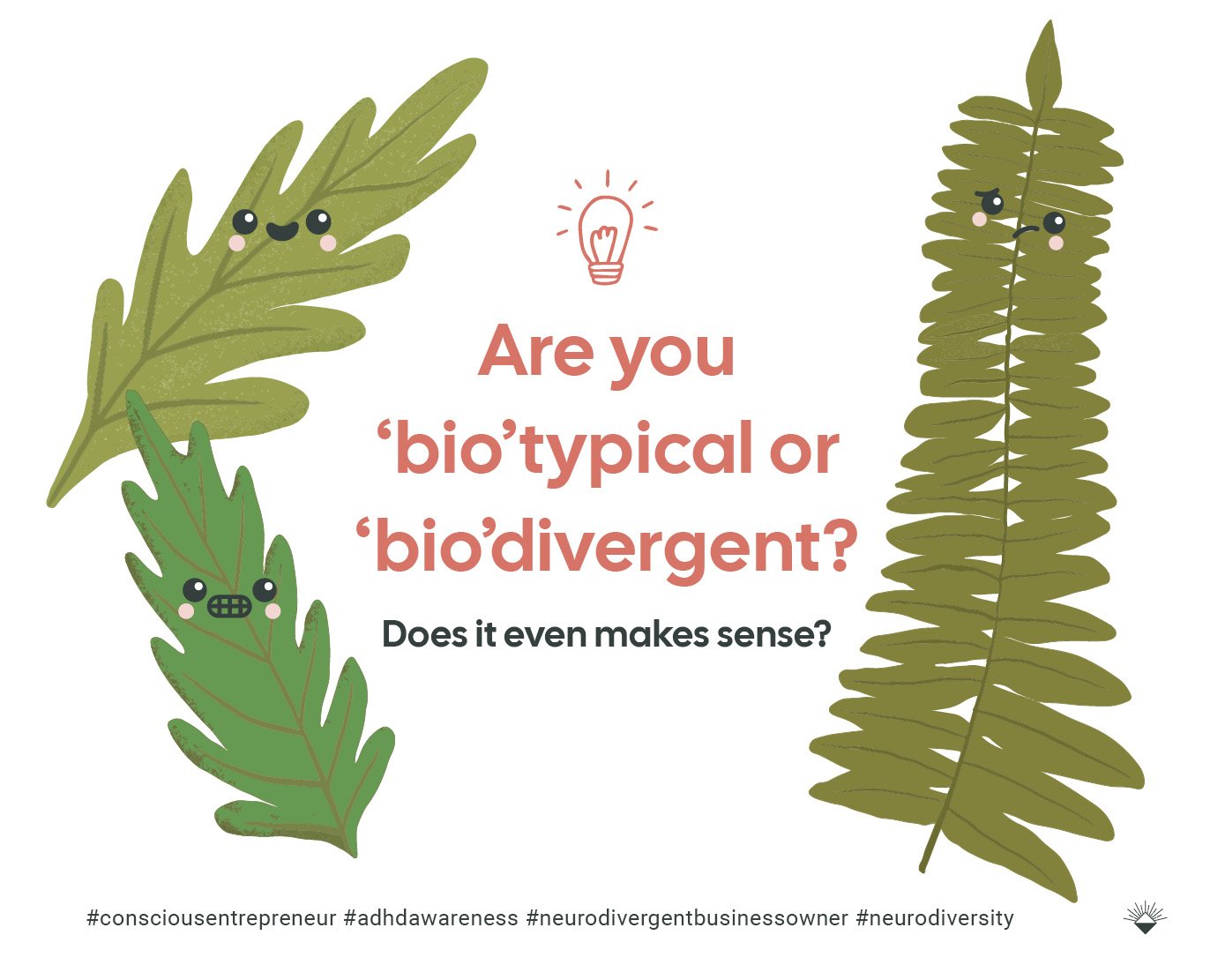
It just doesn’t make sense. I feel someone has sold us a ticket to a reality that is distorted, and for centuries we believed that narrative.
And if something doesn’t fit into the box called society, we become outsiders.
Maybe that sounds dramatic… but history shows us that when something is different, humanity has often done one of three things: ignored it, demonised it, or destroyed it.
A missed early diagnosis led to a late diagnosis in life
Symptoms can be reduced as we grow up, but not because they disappear—only because we get better at adapting. That doesn’t mean your brain wiring is suddenly different.
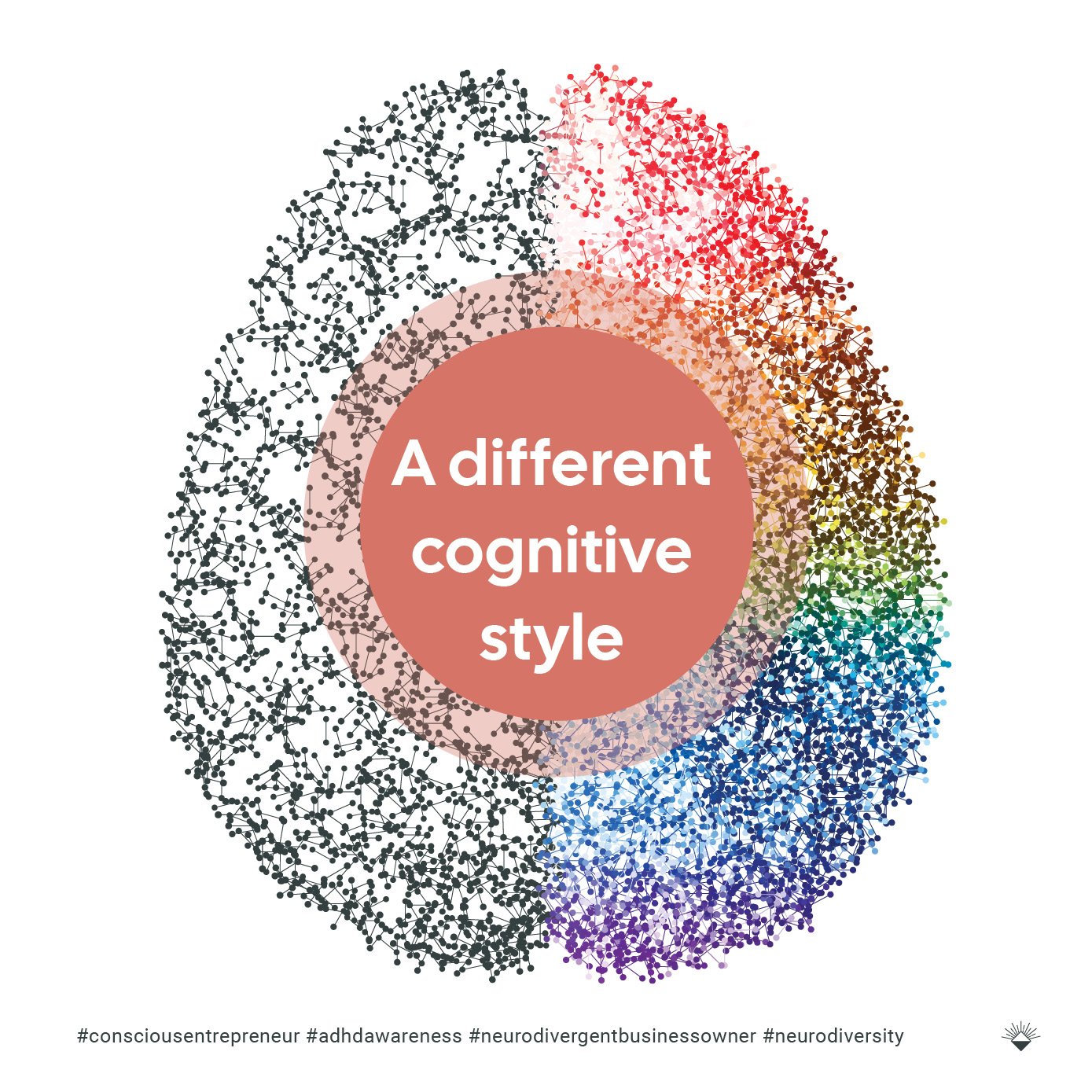
I simply have a different cognitive style. My mind works by association, it creates maps of information—that also makes me curious, because when my mind finds a gap, I need to find the information to improve my inner map.
ADHD makes me highly creative and self-aware, but if not regulated I can burn out easily.
I consider myself very intuitive, which also heightens synesthesia—the ability to feel what others are feeling, including what my senses perceive, its almost like they overlap each other. As a small child I used to associate numbers to colours and letters:
“To me number 1, is white and is the letter ‘i’, number 4 is colour red and letter ‘a’, number 5 is green. 8 is blue etc. Maybe that’s why I’m good at design because I relate words to shapes and colours”
I learned that when differences in children were first studied, the medical system focused primarily on a very specific profile: a hyperactive young boy in Western societies (US, Australia and Europe).
What wasn’t understood until much later is that neurodivergence presents very differently in girls.
Boys tend to externalise. Girls tend to internalise.
From a young age, girls are conditioned—often unconsciously—to be “good,” to please, to behave. We observe, adapt, and adjust.
So instead of being labelled disruptive, we became:
shy, quiet, observant… “different.”
When I read the traits of neurodivergent girls, especially with ADHD and high sensitivity I started laughing.
They were describing little Vanessita.
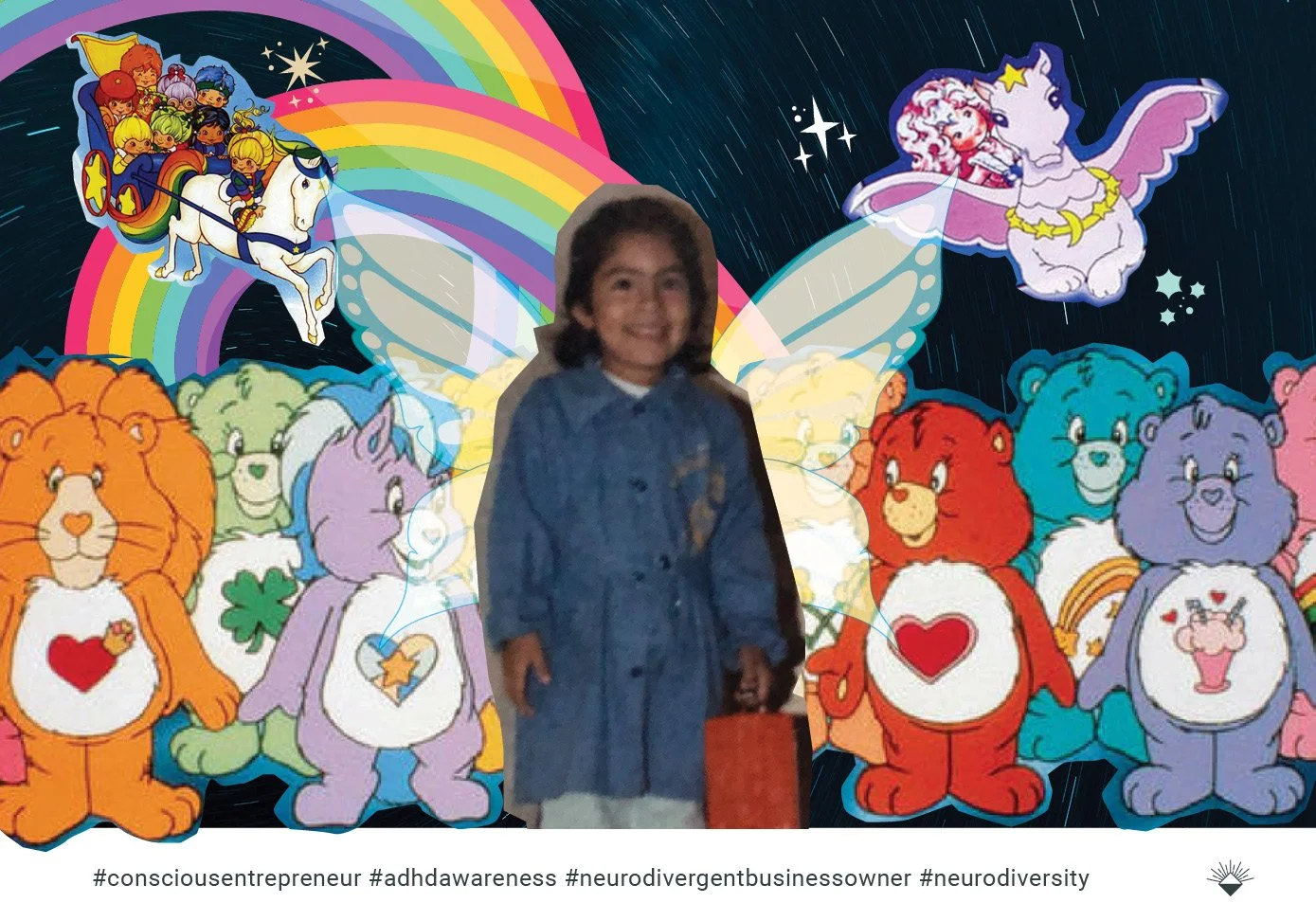
She liked:
Spending time alone in her own little world. She used to imagine being a bee or a hummingbird living inside flowers. She loved CareBears, Rainbow Brite, My Little Pony and The Moon Dreamers… that was her inner magical world, so she had a hard time understanding rough games, arguments, mean kids or injustice. It made her feel fearful, deeply sad and confused.
Vanessita didn’t like rough games, loud environments, or sudden physical contact. Big playgrounds, loud noises, long car rides, they overwhelmed her. To adults it looked like she was grumpy, for a 3 or 4 year old child this was the way of showing she is uncomfortable.
She was:
Extremely self-aware of how others perceived her
Comfortable in small, close friendships but overwhelmed in big groups
Anxious when doing something new or unfamiliar
More likely to whisper than speak up
Often distracted, dissociated, and labelled as forgetful
Extremely anxious in new situations to the point of belly aches and feeling sick
Very observant and aware of adults behavior, emotions and loud noises
Had a very creative mind, adored doing crafts for hours, created fantastical stories
She loved to play with flowers, plants, insects, rocks and snails.
To the world I was a shy, introverted kid and that was it.
A new awakening:
The question stands.
Why so many, especially women, are discovering they are neurodivergent, Aspergers or autistic now?
Because as children—if you were born in the 70s, 80s, 90s—those terms were not mainstream. We didn’t have social media or YouTube or access to so much information as now. We simply didn’t know we didn’t know.
Also, I learned that most data about neurodivergence is based on Western hyperactive boys, and shy little girls were simply treated as shy—not even considered because they were not disrupting classrooms, churches or annoying parents.
So what is happening now is a massive neurodiversity awakening. Those 80s/90s children are now parents, and some have children that are neurodivergent—because around 30% is hereditary, one or both parents may also be neurodivergent.
And these adults are seeing themselves in the tests, remembering their child experiences and their challenges and suddenly—wake up! You know what I mean?
Adapting: Masking, mirroring, copying, people-pleasing and filtering down
The question that kept repeating in my mind was, how did I grow into a competent, happy, healthy adult?
I adapted.
Like many neurodivergent children, I learned to:
mirror, mask, and copy behaviour.
And honestly… the only people who truly know my most unfiltered self is my husband, my family, and maybe a couple of very close friends.
I learned that the below terms are adaptive survival strategies, not “personality traits”, so keep that in mind.
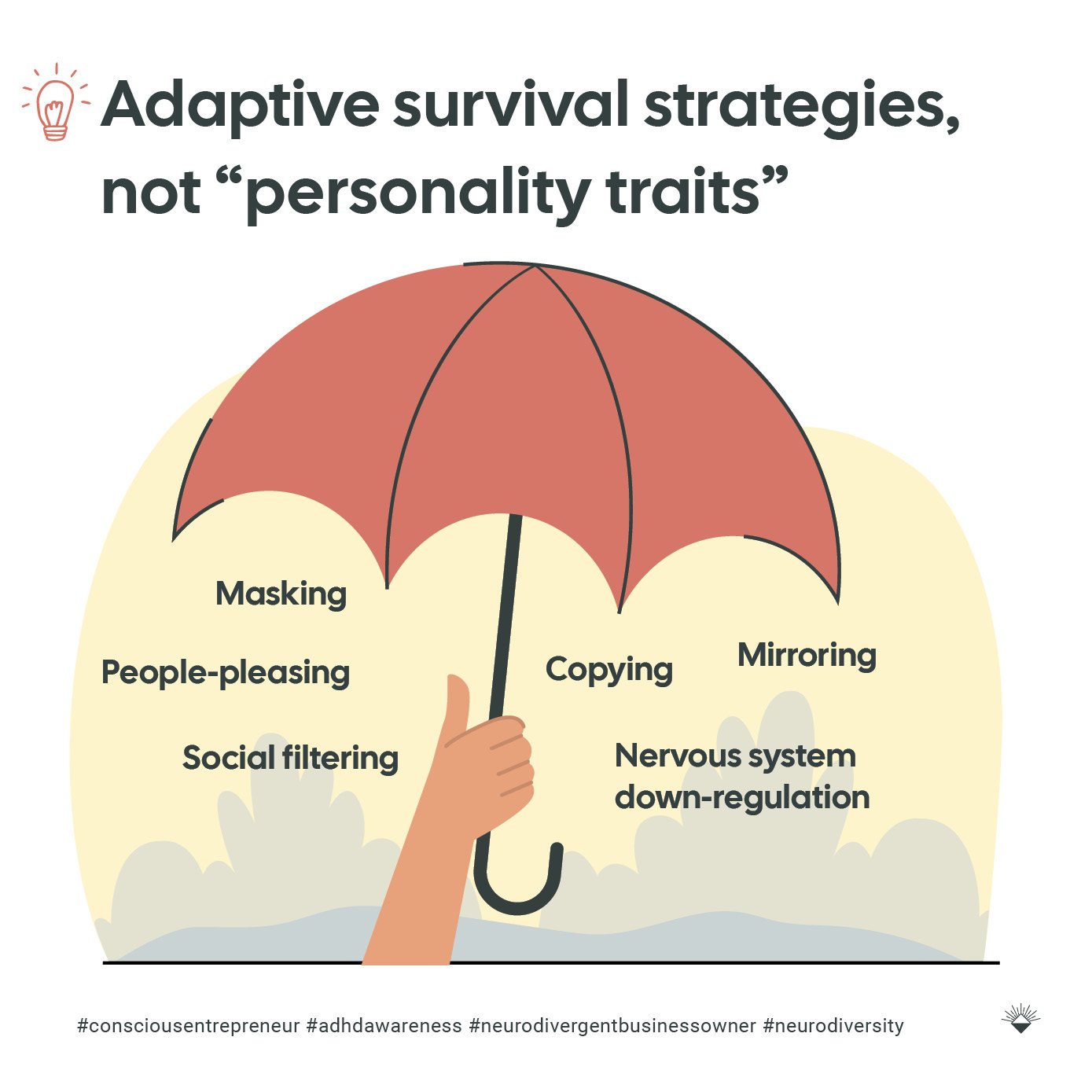
Many neurodivergent people—more so women—have learned from a very early age to develop deep adaptability to social norms, and this includes but is not limited to these:
→Masking
This happens when a neurodivergent person consciously or unconsciously hides their natural traits in order to “fit in” socially.
This can include:
forcing eye contact when it makes you feel uncomfortable
rehearsing conversations before speaking
imitating “socially acceptable” behaviour
dressing in a way that you may not love but that will make you fit in
Masking often develops early in life as a safety response to avoid rejection, criticism, or misunderstanding. Over time, it can become exhausting and disconnect someone from their authentic self.
→Mirroring
The act of unconsciously or consciously reflecting another person’s behaviour, tone, expressions, or energy to create social safety and connection.
For neurodivergent people, mirroring can look like:
copying facial expressions or gestures
matching speech patterns or humour
adapting personality depending on who they are with
It’s often a way to “learn” social interaction when it doesn’t come intuitively or when we miss social cues.
→Copying
This is a more direct form of adaptation where someone learns social behaviour by imitating others rather than intuitively understanding social norms.
This can show up as:
replicating how others speak or behave
following scripts seen in media, peers, or authority figures
adopting opinions or identity cues from others to fit in
Copying is often a developmental strategy used when social systems feel unclear or overwhelming.
→People-pleasing
This is a behavioural pattern where someone prioritises the needs, emotions, or expectations of others over their own in order to maintain safety, acceptance, or harmony.
It can include:
saying yes when you mean no
avoiding conflict at all costs
over-explaining or apologising
constantly scanning others for emotional cues
In neurodivergent individuals, people-pleasing is often linked to a history of being misunderstood, corrected, or punished for natural behaviour. Sadly, it may create an inner narrative that something is wrong with us.
→A big one: Filtering down (social + nervous system adaptation)
Filtering down is the process of reducing, editing, or compressing one’s natural expression in order to feel safe, accepted, or not overwhelm others.
It can happen in two connected ways:
1. Social filtering
This is when a person consciously or unconsciously edits what they say or express before speaking. It can include:
overthinking sentences before speaking
withholding thoughts, ideas, or emotions
toning down personality, excitement, voice volume or intensity
only sharing “safe” or socially acceptable parts of self
2. Nervous system down-regulation
This is a physiological response where the body automatically reduces expression, energy, or visibility in order to avoid overstimulation or perceived threat. It can look like:
becoming quieter or emotionally contained in groups
shrinking presence in busy or intense environments
holding back laughter, excitement, or strong emotion
feeling “smaller” or less expressive without choosing it consciously
For many neurodivergent people, filtering down becomes a long-term adaptation, especially in environments or societies (families) where authenticity was not received safely or where intensity, sensitivity, or difference was misunderstood.
Over time, it can become so automatic that a person forgets what their unfiltered expression actually feels like. Wild.
Hyperfocus: A gift and a nightmare
The thing is, ADHD for me is not a deficit in attention. It feels like the opposite! Attention on things that others may consider irrelevant, and therefore not socially valued. Especially within highly structured societies or deep conditioned minds.
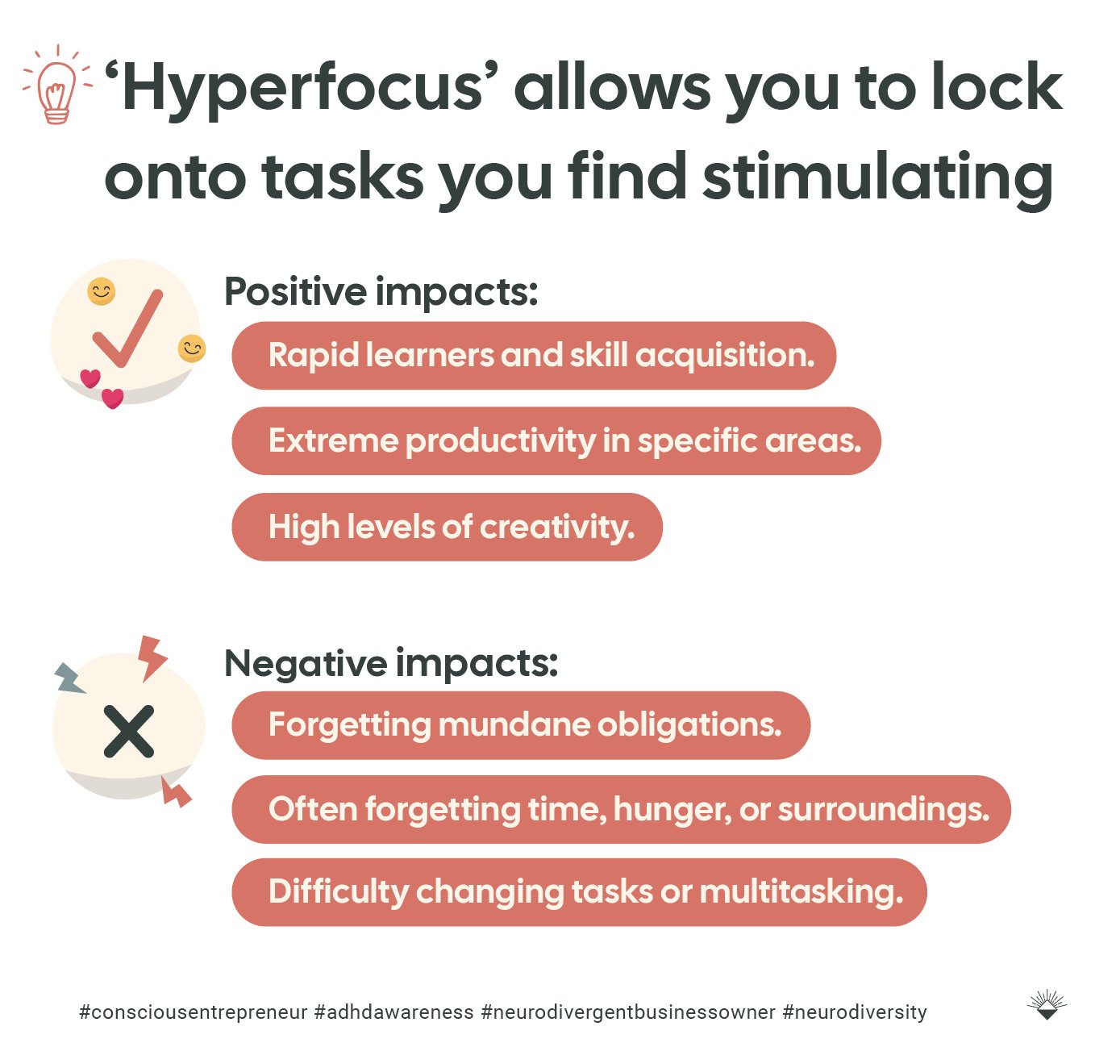
‘Hyperfocus’ is an intense state of deep, prolonged fixation on a specific task or interest that may seem not important to others, often experienced by (but not limited) neurodivergent individuals—particularly those with ADHD and autism. Hyperfocus allows you to lock onto tasks you find stimulating, often forgetting time, hunger, or surroundings. You get into a trance-like state.
This is a big one for me—in the corporate world too many meetings were not ideal for me, they would constantly cut my creative flow and disrupt my work, so then I would stay working late to compensate with all I needed to do.
Through my (now mildly obsessive) research—which I understand is part of ADHD, I realised hyperfocus manifest in me by the ability to devour information non-stop until my brain has enough to build new associations, make connections, and create meaning. Only then can I move on to my next obsession… and repeat the cycle. Yes sometimes its exhausting but it’s also what makes me, me.
Hyperfocus has served me well my entire life—and even more so now as an entrepreneur and educator. The ability to zoom in, to see details in life, and zoom out, to see the whole picture and discover patterns.
(Also… jumping between ideas and going off on branches while speaking? Yes, that’s part of ADHD too—just so you know.)
During my almost two decades as a corporate designer, I worked in many different set-ups (freelance, studios, client-side) across retail fashion, cosmetics, finance and government. Each industry manages creative professionals differently, but what stood out for me was: I thrive with tight deadlines (it was a horror story).
I’m a fast thinker, a problem solver, highly creative, and I was always able to meet deadlines. I was praised for it.
Knowing about ADHD explains this so much. My mind would go into hyperfocus and perform exceptionally well under pressure—it’s what made me “good” at what I did.
But over time, that same pattern came at a cost: Adrenal fatigue, chronic stress, digestive problems, infertility… my body eventually said: enough.
Around 2017, it started to backfire.
To be totally honest, I was only fully able to see these imbalances when I moved to New York, because for the first time I had to drop every single label I carried. When we moved to Manhattan I left my corporate job, I knew no one, I had no job, no work permit—I couldn’t even work at Trader Joe’s—and no pregnancy. I experienced what in the spiritual world we call The Dark Night of the Soul, Ego Death or The Deconstruction of Self… not the happiest time in ones life.
For context, right before we left Sydney we used our last embryo which didn’t work. Moving to New York was that moment where we said: this is it, let’s close this chapter and let’s start healing.
I was feeling like sh*t most of the time—totally demotivated, lost, confused, no passion, no inner compass. Yes living in this amazing city, but not knowing where I was going.
And yet… somehow, I knew there was a tiny light within me.
And I chose to focus on that… and follow my curiosity.
“We have the power to alchemise the story that was written for us.”
The following five years were the most amazing time in my life—as a partner, as a friend, as an entrepreneur and as a human.
Thinking outside the box
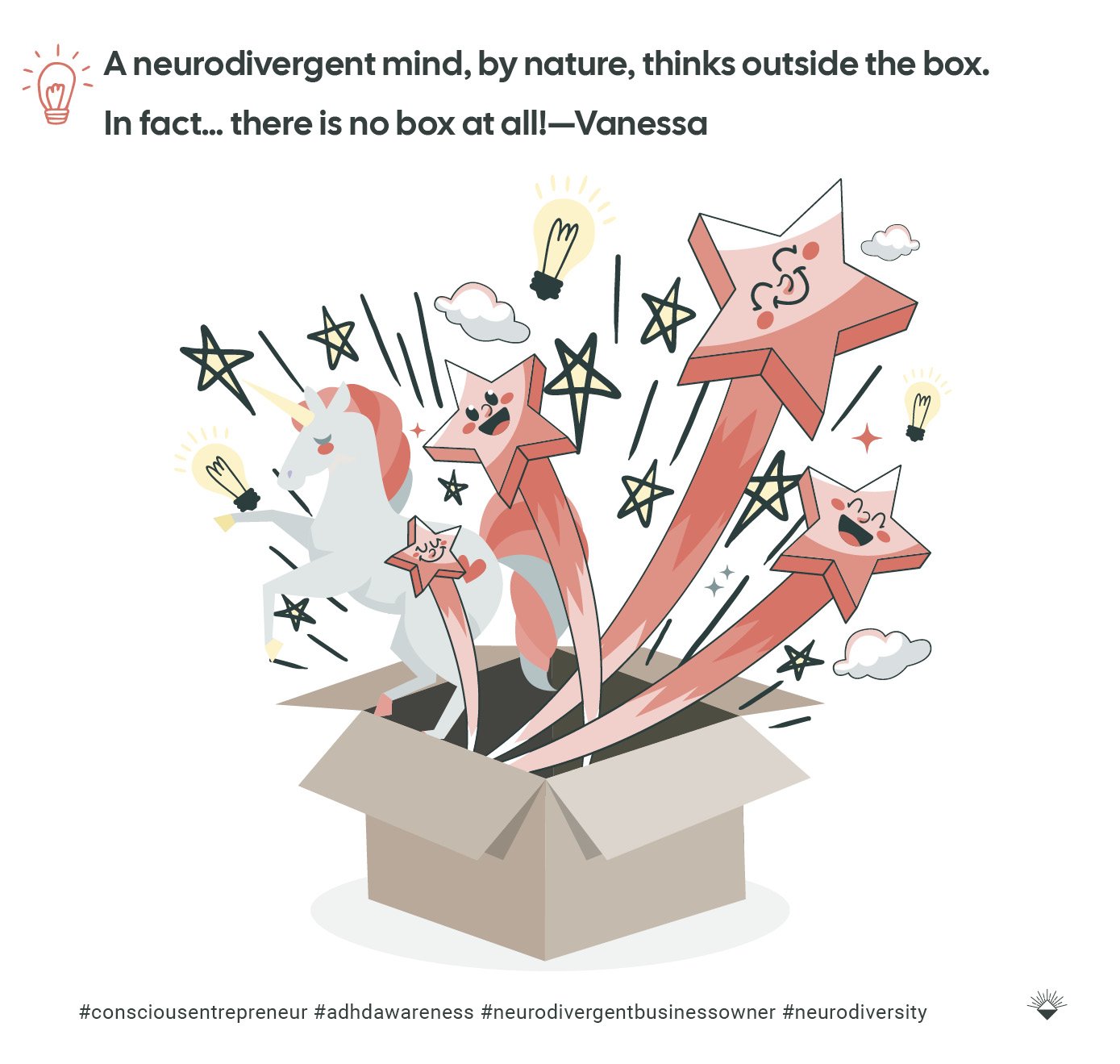
“A neurodivergent mind, by nature, thinks outside the box.
In fact… there is no box at all!”
Can you see how challenging it is to fit into a box that was never really created for us?
Why is it so hard to live a “normal” life? Why does it feel so challenging? Why can’t I just live and not ask so many questions?
I used to think this all the time as a teenager and young adult. No one knew. I thought it was just me being weird.
I’ve since realised I was using so much of my vital energy force trying to fit in—trying to be and do things like other people and that is exhausting.
“And then I wondered…
How can you make a star fit in a square box?
How can a million sparkles be limited by a small box?
How can a unicorn stay quiet in a small box when it knows deep down it was born to fly and be wonderfully unique?And more importantly… Why have we been minimising ourselves on purpose?”
An emotional rollercoaster
After my new discovery came the emotional rollercoaster.
Many days of rage and deep emotion unfolded—grief, sadness, compassion, joy. My days looked like crying and laughing at the same time, dancing and jumping in my hotel room until exhaustion, reading, learning, and then repeating the cycle again for several days.
Then came the inevitable: frustration and rage. How am I only finding this out now? What about my parents, my teachers, my therapists—anyone?
Then the “if” thoughts arrived. What if I had known this since early childhood? What if during design school? What if… what if…
And then, underneath it all, empathy emerged.
“How many people, how many women out there are like me? And have no idea”
I feel so much compassion for my parents. When I shared the news about my brain with them, they had no idea. No one ever mentioned anything like this. They simply followed what my preschool teachers recommended at the time, doing what they believed was best for my development.
They helped me remember experiences from my childhood—many so vivid that I can still clearly recall them now. They did the best they could with the information they had at the time for little Vanessita.
I noticed I was needing naps as my nervous system began to regulate.
My body was integrating. During sleep, our neural pathways reorganise and settle, which is why after deep therapy, somatic work, or energy healing, we can feel profoundly tired. The body knows—it’s completely normal.
It felt like my entire life story was being gently rewired—given new meaning, new understanding, and a different way of seeing everything.
Clarity and deep focus came next, and the realisation that:
“We are not wrong.
Our paradigm is wrong.”
The fact is, from a spiritual, soul-level and energetic lens (because this is how my multidimensional mind works and I also work with energy facilitation), this is a master plan that I am extremely impressed by—how my higher self, my soul, was able to plan in such detail deserves a standing ovation.
I mean, if my life was a TV show, the producers and writers would be winning Grammys because… hello?! The plot twists are just insane. It is a brilliant master plan. It keeps getting better and better!
I’m truly excited about what will be unfolding.
Resources and research
Disclaimer:
I don’t have a formal medical diagnosis, and I’m not a psychologist. I’m a woman who discovered her own neurodivergence and has a voracious drive to know information, all triggered by my own curiosity.
What I do have is awareness, information… and my lived experience.